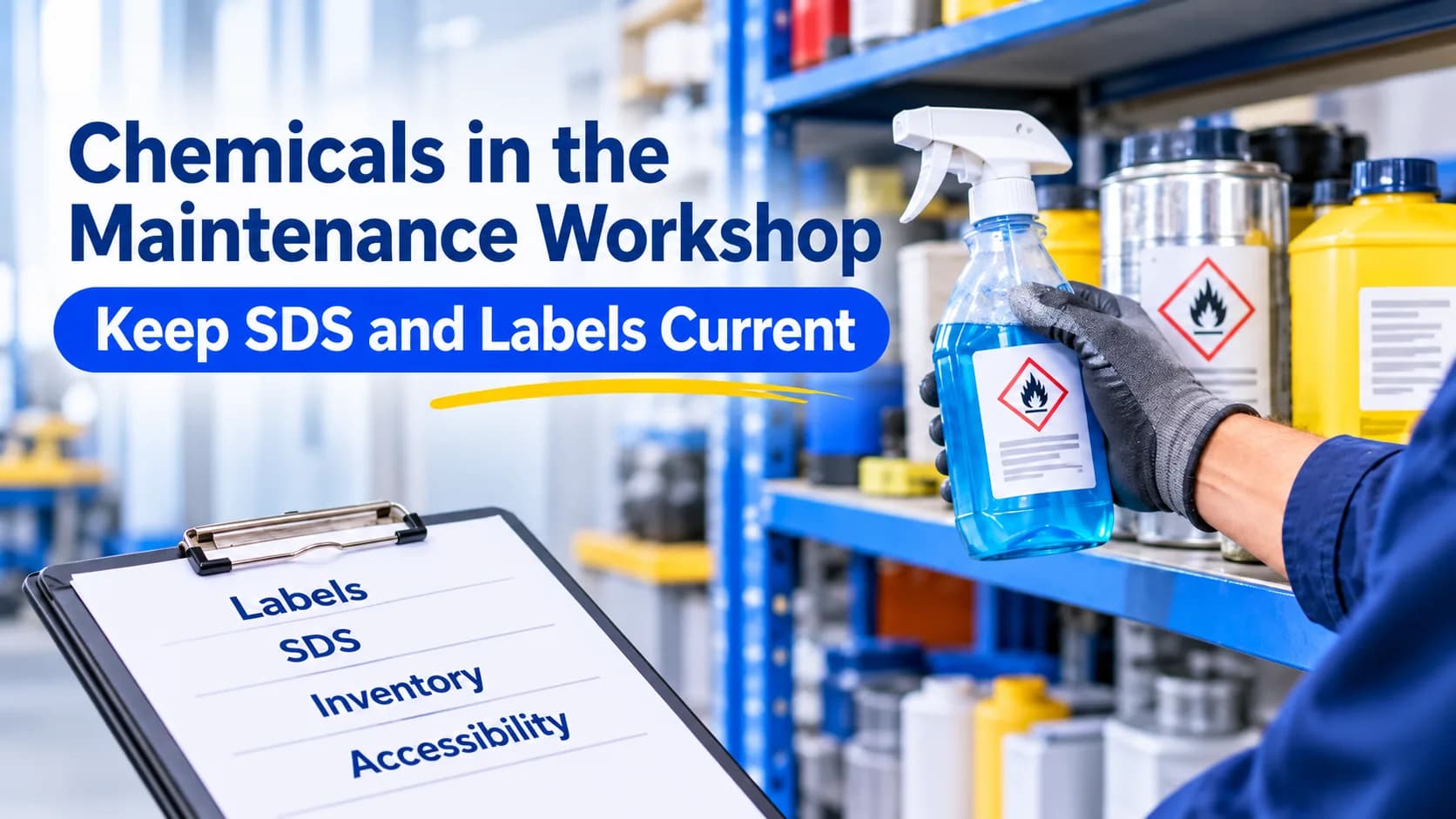
Secondary container labels and safety data sheets (SDSs) are the part of chemical storage that can still be wrong after the monthly inspection finds nothing. The cabinet doors are shut and the spill tray is dry. But the spray bottle of brake cleaner on the bench has no label, and the tech who picks it up cannot tell what is inside or which gloves to wear.
A typical workshop shelf holds hydraulic oil, grease, solvents, brake cleaner and coolant, and much of it has been poured into spray bottles and oil cans. Many storage inspection forms cover leaks, open lids and overfilled cabinets. They have no line for whether each label is readable, or whether the SDS on file matches the product.
Both checks fit into the monthly inspection as a 15-minute add-on. Start with the labels on the shelf, then the SDS file, then whether a tech on any shift can reach it.
Why SDSs and labels go out of date in the workshop
Many gaps in a workshop's SDS file start with products that reached the shelf without going through purchasing:
- A contractor leaves a half-used can of thread sealant or a pail of cutting fluid behind after a shutdown job.
- A supplier's rep hands over a sample degreaser to try.
- A tech buys brake cleaner at the parts store during a weekend breakdown because the storeroom was locked.
None of these arrives with its SDS filed, and none gets added to the chemical inventory.
Decanting into a spray bottle leaves the supplier's label on the drum, and the labels that remain get soaked in oil, wiped with solvent and heated next to compressors until the print fades. OSHA requires workplace labels to be legible and in English under 29 CFR 1910.1200(f)(10), so a label nobody can read does not comply.
The 2024 update to OSHA's Hazard Communication Standard (HazCom) sets dates for acting on revised SDSs. Where a revised SDS identifies a new hazard, employers must update the written HazCom program, training, and any in-house labels that show only the product name and general hazard information. The deadline is November 20, 2026 for single substances and May 19, 2028 for mixtures, under 1910.1200(j). Most degreasers, coolants and lubricants are mixtures, so the 2028 date covers most of the shelf.
Secondary container labels: what OSHA expects
Under OSHA's HazCom labeling requirements, the supplier's label stays on the container. Paragraph 1910.1200(f)(9) bars an employer from removing or defacing the label on an incoming container unless the container is immediately marked with the required information. A label made unreadable by oil or solvent needs the same treatment, with the replacement on the container before it goes back on the shelf. That replacement can be built from the product's SDS with a secondary container label generator, which fills in the pictograms, signal word and hazard statements and adds a QR code that opens the SDS.
Secondary container labeling covers every workshop container of a hazardous chemical, not only the ones that arrive from a supplier. Under (f)(6), each one must carry either the full supplier label information or a shorter format. The shorter format is the product identifier (the product name as it appears on the SDS) plus words, pictures or symbols that give at least general information about the hazards.
The exemption most shops rely on is narrow. Paragraph (f)(8) lets a portable container go unlabeled only when it was filled from a labeled container and is for the immediate use of the employee who filled it. A 1990 OSHA interpretation letter adds that containers used by anyone else, including employees on other shifts, must be labeled. A spray bottle of degreaser left on the bench for the night shift needs a label, because someone other than the person who filled it will use it.
Hazard Communication, the standard behind these labeling rules, was OSHA's second most cited standard in fiscal year 2025, with 3,010 violations, according to Safety+Health magazine's report of OSHA's final figures.
What goes on a secondary container label?
Copy the label content from the product's SDS rather than from memory. Section 1 of the SDS gives the product name and Section 2 gives the hazard information, so a full label carries:
- the product name, exactly as it appears on the SDS
- the pictograms
- the signal word, "Danger" or "Warning"
- the hazard statements
The shorter format meets the rule only when the label, together with the SDS and the rest of the HazCom program, gives employees the specific physical and health hazards of the chemical. In an oily workshop, print on label stock rated for oil and solvent, or the new label may be unreadable by the next inspection.
The SDS and label checklist for your monthly chemical storage inspection
Check labels and SDSs during the same monthly inspection as the cabinets and spill kits, and record the findings on the same form.
- Every container on the shelf and the benches, including spray bottles, oil cans and squeeze bottles, needs a readable label that matches what is inside. Pick each one up and read it. Replace a missing or worn label on the spot. A bottle whose contents nobody can identify comes off the shelf for disposal.
- Each product on the shelf needs a matching SDS in the SDS binder or electronic system, filed under the same product name as its label. Keep the newest version the supplier sends. Manufacturers must add significant new hazard information to the SDS within three months under 1910.1200(g)(5), and once you learn of that information, the workplace label has to be revised within six months under (f)(11). When a product leaves the workshop for good, archive its SDS rather than throwing it out. OSHA's records rule, 29 CFR 1910.1020, does not require the SDS itself to be kept, but it does require a record of the chemical's identity, where it was used and when, for 30 years. Archiving the SDS with a note of where the product was used and the dates it was in use covers the 30-year record.
- Contractor leftovers, samples and emergency buys that arrived since the last inspection need an SDS before anyone uses them. Add each one to the chemical inventory, the list of hazardous chemicals your written HazCom program requires.
- A tech on nights or weekends has to be able to reach the SDSs without a key, a login or a call to the day supervisor. Under 1910.1200(g)(8), SDSs must be readily accessible to employees during each work shift, and electronic access is acceptable as long as it creates no barrier to immediate employee access. The quickest test is to ask a night-shift tech to pull up one SDS.
- Each finding goes on the inspection form with an owner and a fix date, and any finding still open moves to the top of next month's form.
Habits that keep labels and SDSs current between inspections
The monthly inspection finds gaps. A few standing habits make new gaps less likely.
- Rotate the inspection among techs, so more than one person knows where the SDS file is kept and how a label gets made.
- Keep a label printer or a roll of blank labels in the storeroom, so a tech can replace a label on the spot instead of requesting one.
- Set a rule at receiving: no SDS, no shelf. Receiving holds a new product until its SDS is filed.
- Compare the chemical inventory with the SDS file once a quarter. SDSs for products no longer in use go to the archive, and any product without an SDS gets one requested from the supplier.
- Give a short toolbox talk when a revised SDS adds a hazard. HazCom requires training whenever a new chemical hazard that employees have not been trained on is introduced into their work area, under 1910.1200(h)(1).
Add the label and SDS checks to your next inspection form
The monthly inspection already covers cabinets, spills and housekeeping. Secondary container labels and the SDS file tell techs what each chemical is and how to handle it. Both can be checked during that same inspection. Add the label and SDS checks to next month's form, give that inspection to whoever is next on the schedule, and compare what the first three inspections find. A free chemical storage monthly inspection template is available in the FreeMaint template library.
About the author
Arisha Alif Khan is an EHS and chemical safety specialist at SDS Manager. Her background spans biochemistry, biotechnology and public health, and she works with SDS Manager's product and regulatory teams.